INTERΟΧΥSTRESS
Unraveling Cellular Resilience: Crossroads of hypoxia and other critical stress-response pathways in cancer cells
About the Project
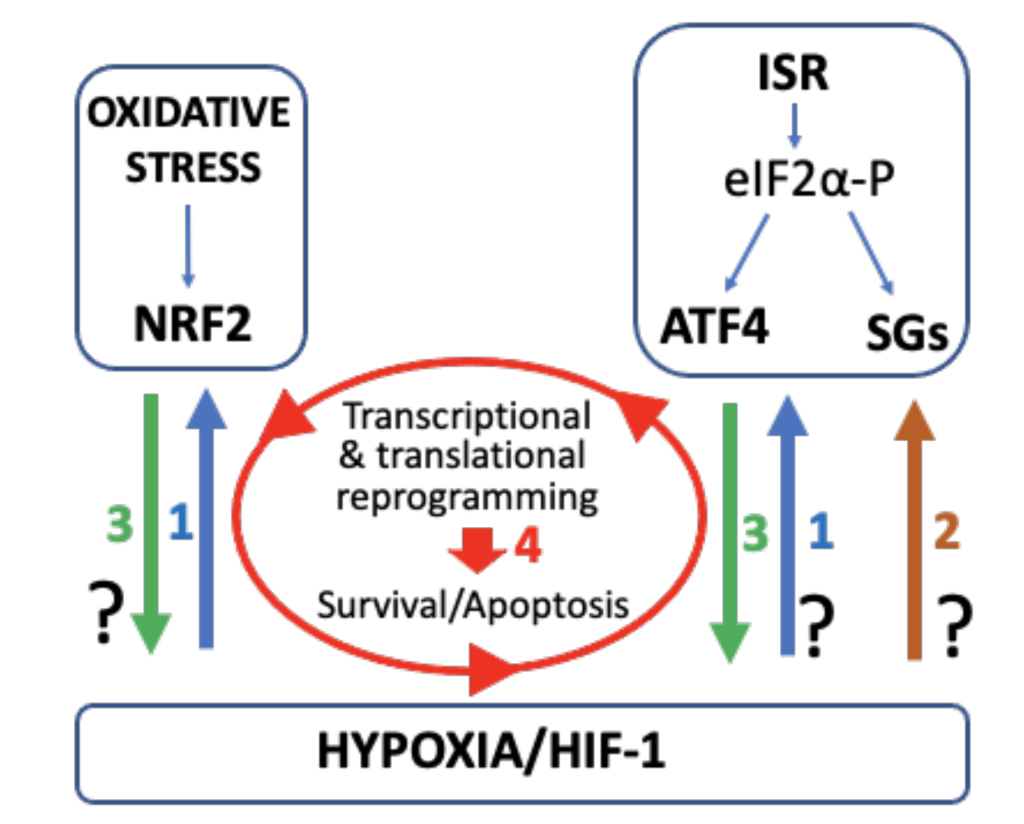
Cellular plasticity and survival requires adaptation to challenging environmental conditions. This is achieved through activation of different stress-response pathways, such as the Integrated Stress Response (ISR), the response to oxidative/electrophilic stress and the response to low oxygen (hypoxia). These pathways leading to activation of transcription factors ATF4, NRF2 and HIF, respectively, are also exploited by cancer cells in order to survive in the harsh tumor microenvironment. Distinct stress-response pathways do not function in isolation but are rather parts of operating cellular networks, as cells encounter a wide variety of stress conditions. Determining how different stress pathways are integrated within a cell can allow their simultaneous targeting in order to eliminate tumor cells without inducing drug resistance. Although the aforementioned critical pathways influence each other, their crosstalk and their synergistic effect at genome-wide level is poorly understood. The principal aim of INTEROXYSTRESS is thorough analysis and understanding of the mechanistic and functional connections between the cellular response to hypoxia, the ISR and NRF2 activation.
Objectives
By deciphering how and why the cellular hypoxic response and other important stress-response pathways converge into distinct biological outcomes, we aim to provide new targets for novel therapeutic strategies for conditions characterized by oxygen deprivation. To explore their interplay and the underlying molecular mechanisms we will address the following:
1. Ηow the transcriptional output of the ISR and/or NRF2 activation is modified in cells that have been grown under hypoxia.
2. Ηow hypoxia affects the morphology, protein/RNA/m6A composition and dynamics of stress granules (SG), pro-survival membraneless RNA-protein condensates, the formation of which is the most characteristic and visible feature of the ISR.
3. Ηow activation of the ISR and/or NRF2 influences the HIF-1-mediated response to hypoxia.
4. How combined activation or inhibition of stress-response pathways affect the chemoresistance of cancer cells and their adaptation to low oxygen conditions.
INTEROXYSTRESS at a glance
Grant ID: 24795
Starting Date: 18/11/2025
Duration: 48 months
Host Organization: Faculty of Medicine, University of Thessaly
Managing Body: Research Committee of the University of Thessaly
Funding Agency: Hellenic Foundation for Research & Innovation (H.F.R.I.)

The research project INTEROXYSTRESS is implemented in the framework of H.F.R.I. call “3rd Call for H.F.R.I.’s Research Projects to Support Faculty Members & Researchers” (H.F.R.I. Project Number: 24795).